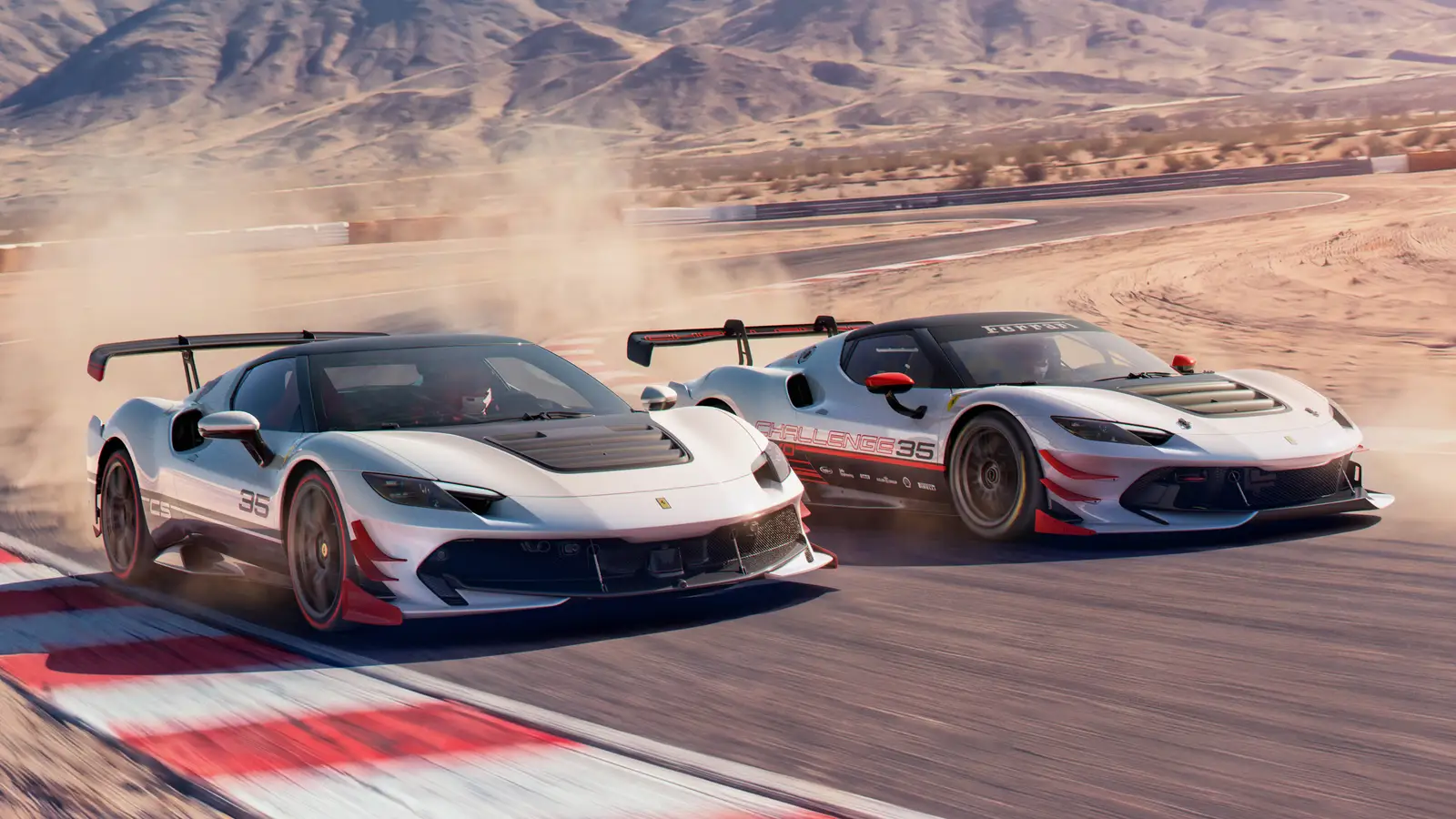
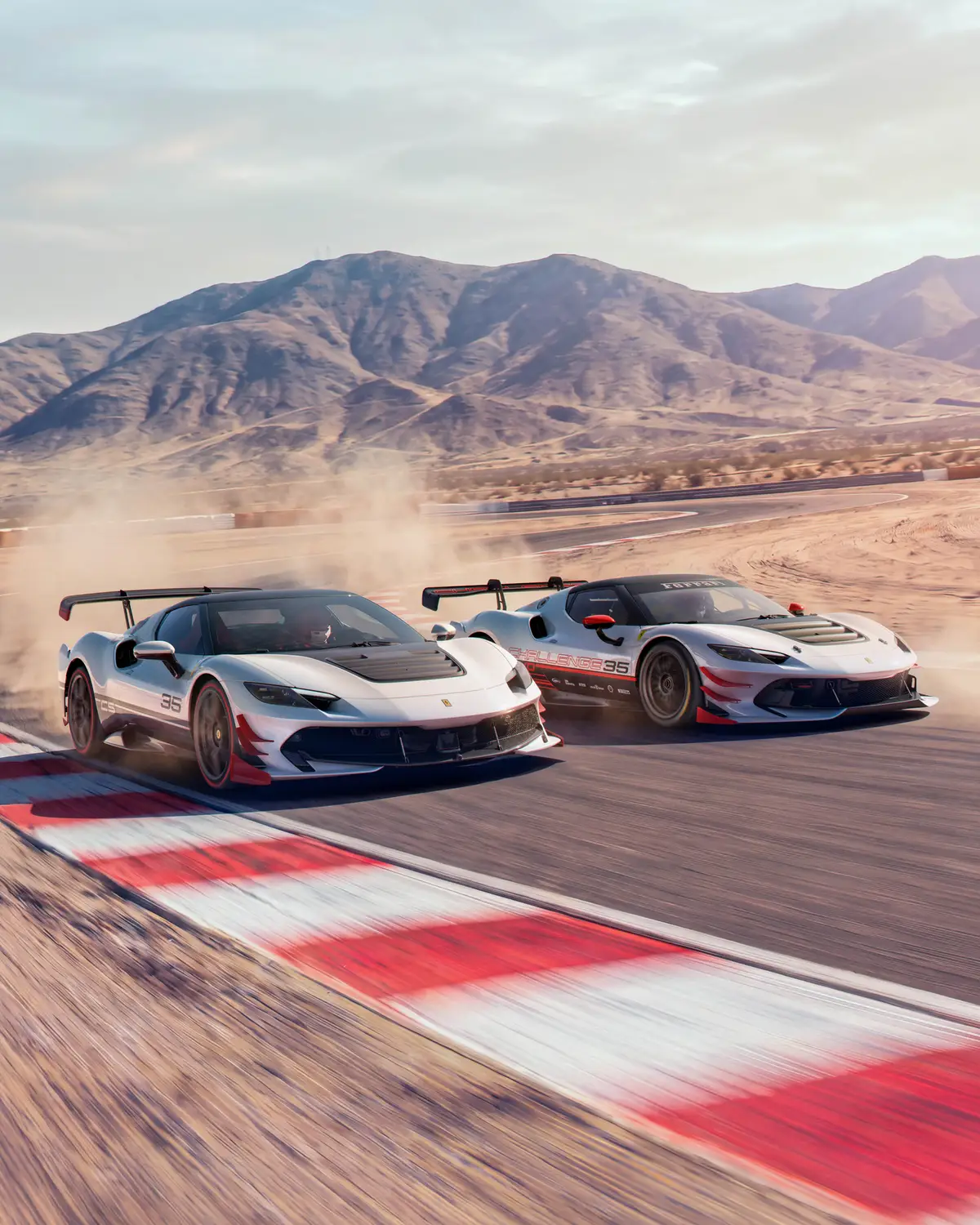
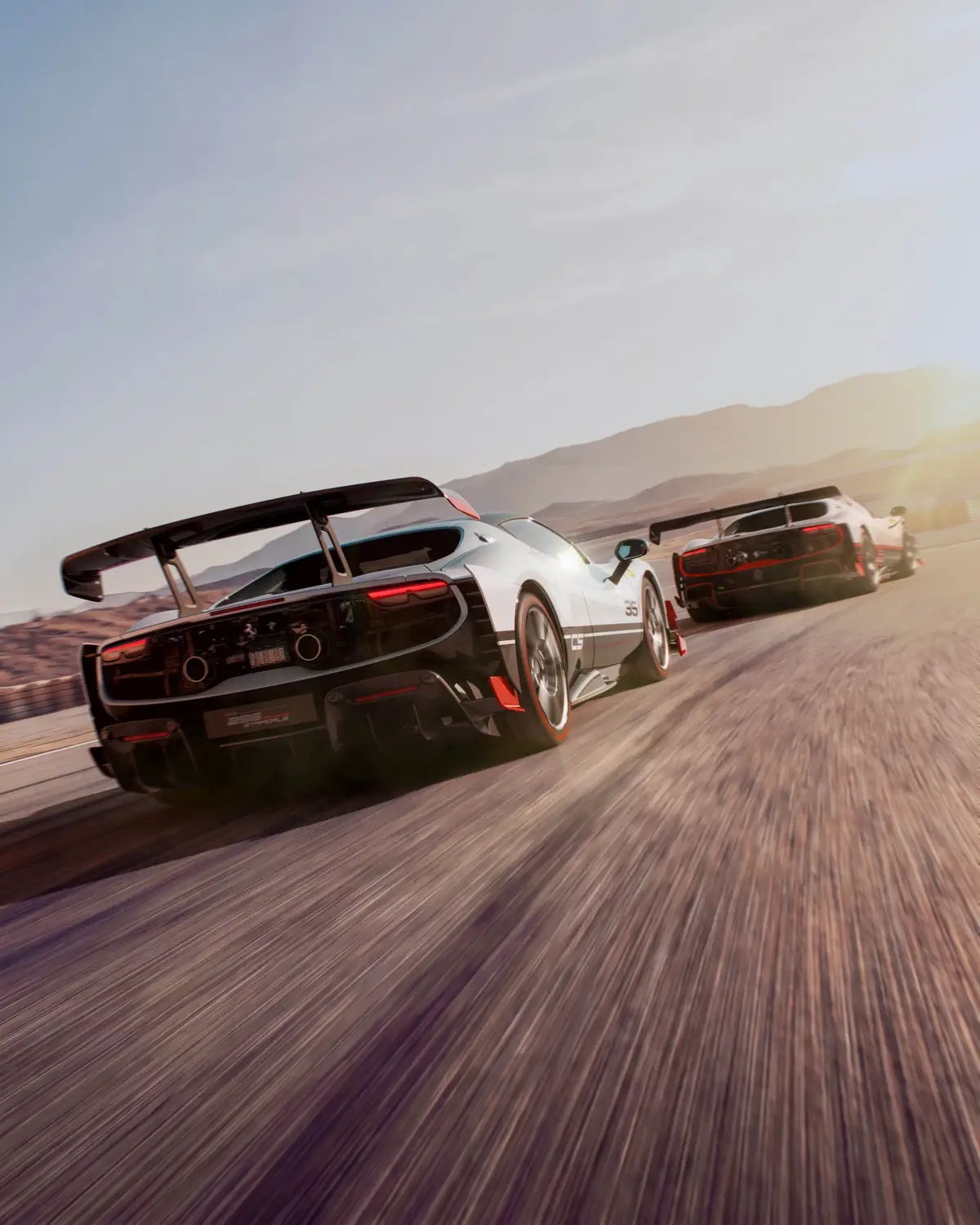
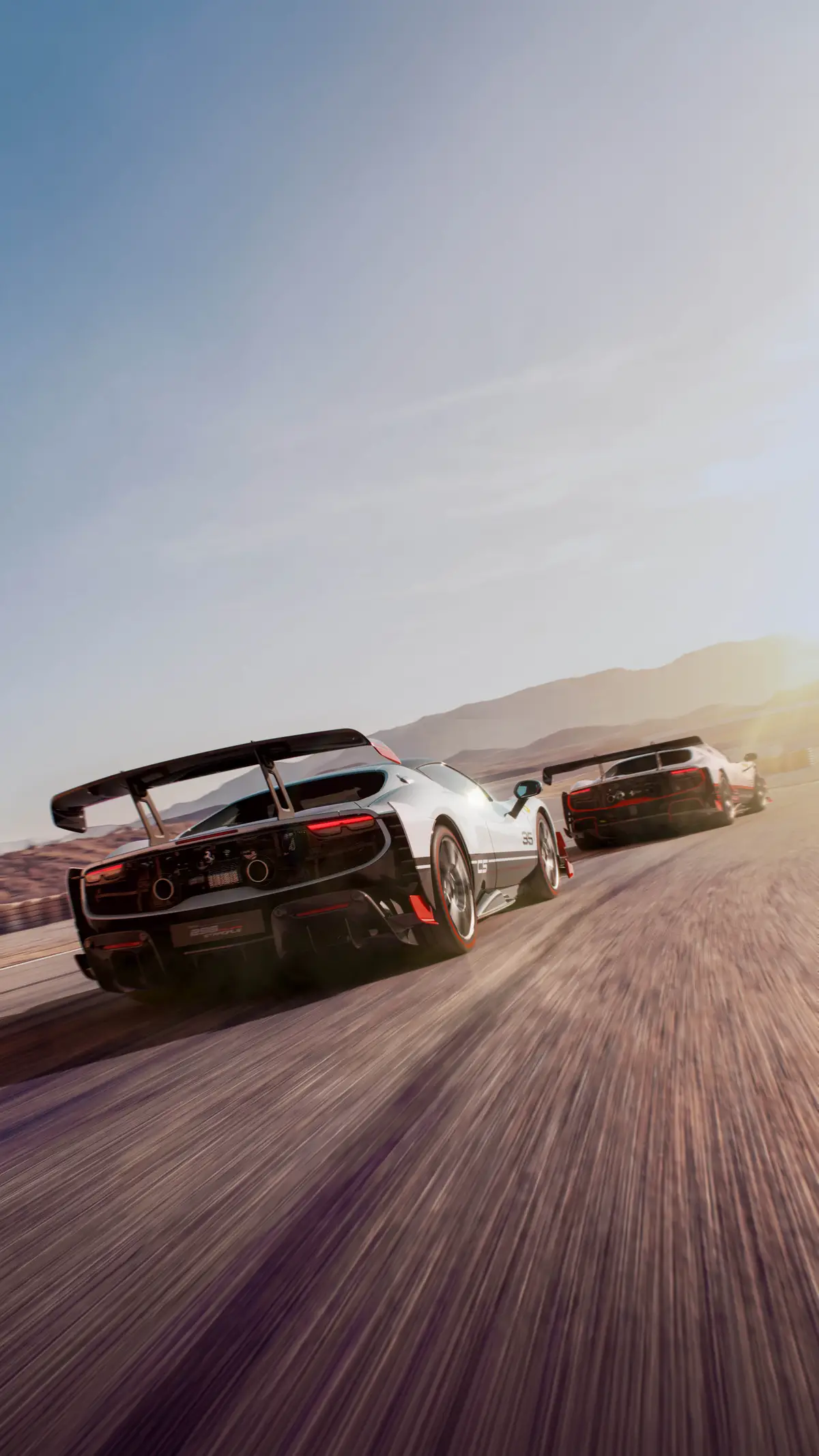
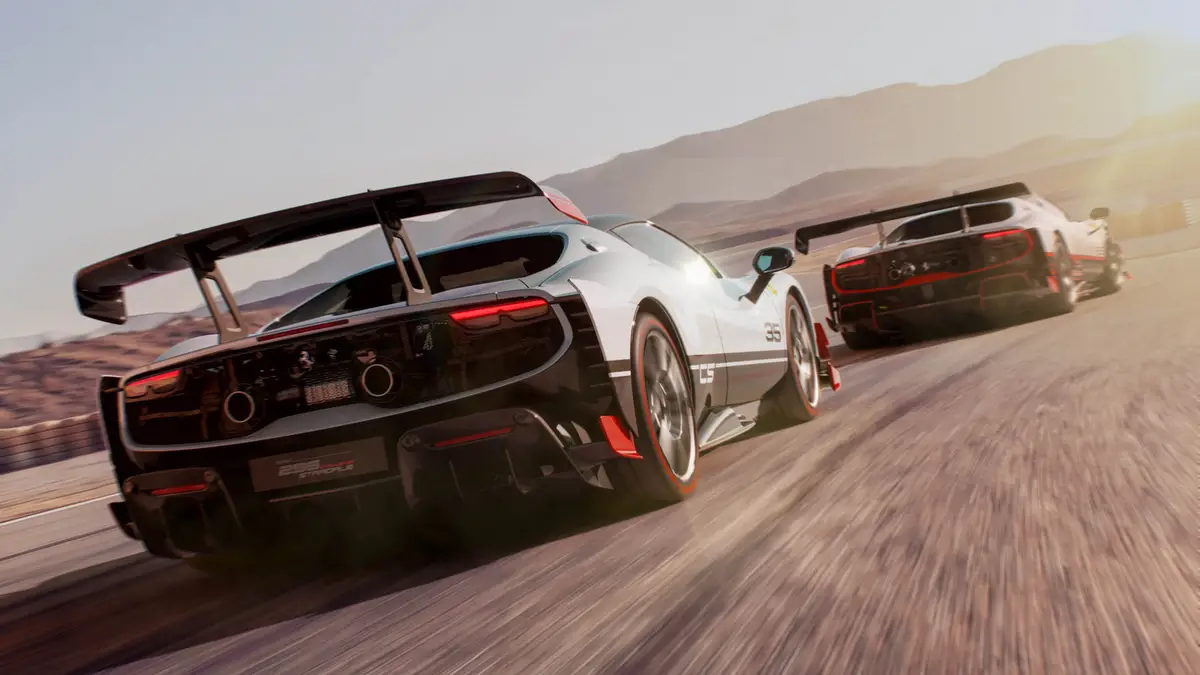
The 296 Challenge Stradale is the Ferrari in the current range that can offer the most direct link to a race car; the 296 Challenge EVO sets the performance benchmark for the Ferrari Challenge with an eye towards 2027.
The cars are powered by a 120° twin-turbo V6 without hybrid assistance, capable of delivering 670 hp (296 Challenge Stradale) and 700 hp (296 Challenge EVO).
The 296 Challenge Stradale generates 617 kg of downforce at 250 km/h; the 296 Challenge EVO increases maximum downforce by 12% and reduces drag by 4% in the Low Drag configuration compared with the previous version.
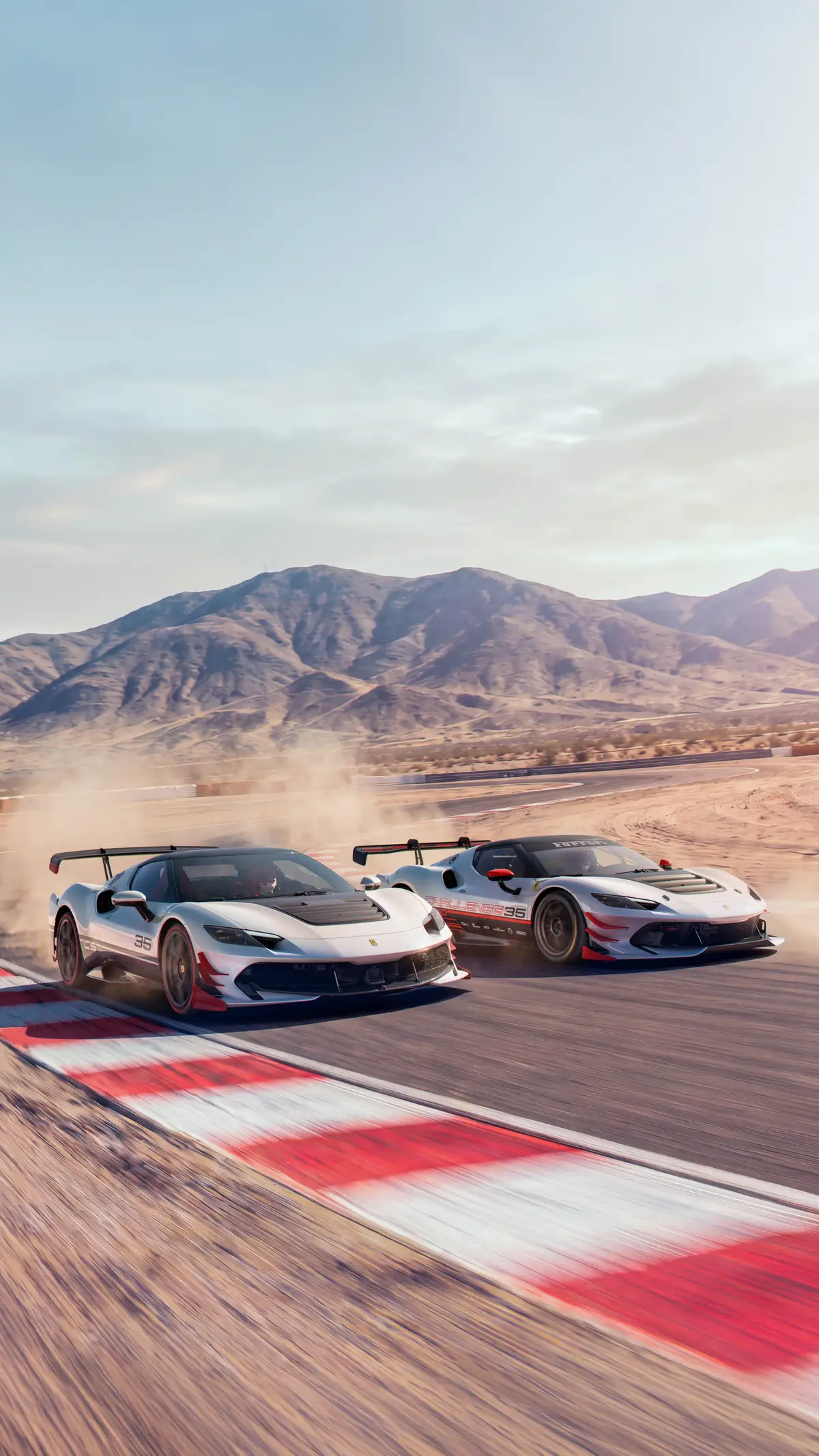
The cars share a design philosophy focused on maximising precision, stability, and consistency of performance, without compromise.
On the 296 Challenge Stradale, this approach results in a more stripped-back, direct, and physical driving experience, while on the 296 Challenge EVO, it is tailored to maximise performance in Ferrari Challenge races.
Their joint unveiling at the Ferrari Finali Mondiali highlights the continuity between the Ferrari Challenge, racing development, and road cars.
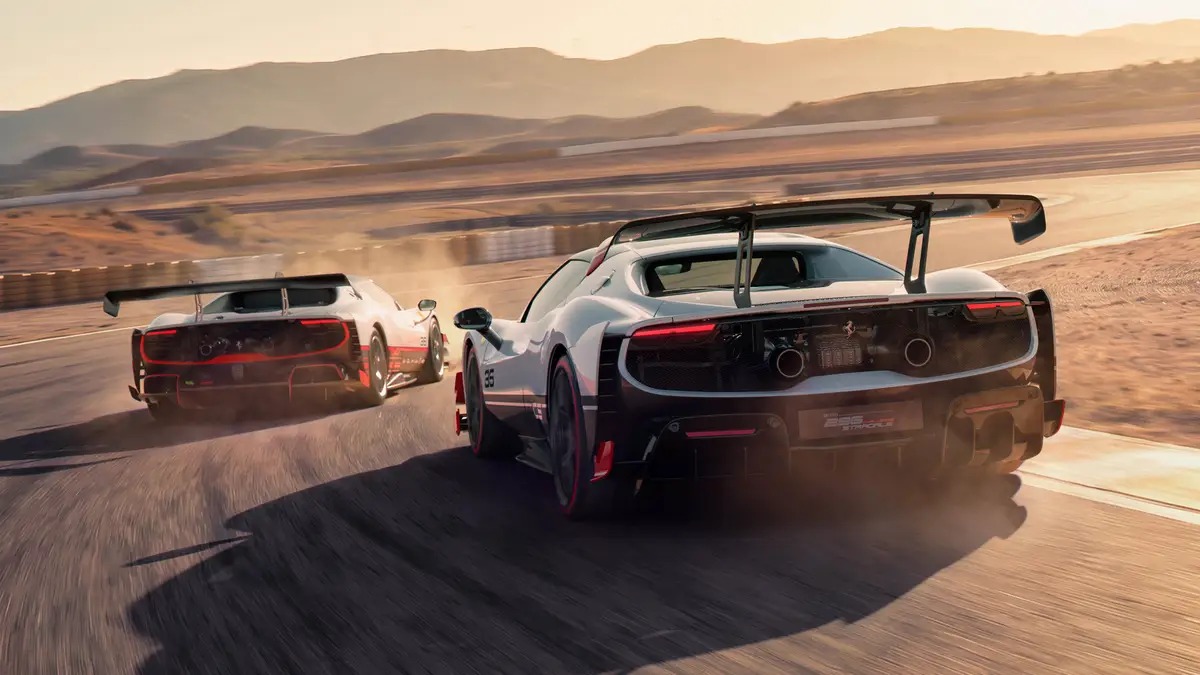
Montmeló (Spain), 21 November 2026 – Ferrari today unveiled the 296 Challenge Stradale and 296 Challenge EVO, two new cars developed in close collaboration to highlight the symbiotic bond between the Prancing Horse’s race cars and production cars, as well as the exceptionally high level of technology transfer that sets them apart. The 296 Challenge EVO builds on the car that redefined the standards of the Ferrari Challenge and will make its debut in the 2027 season, while the 296 Challenge Stradale brings the technical essence and pursuit of uncompromising performance to a road-legal vehicle.
The cars were unveiled during the 2026 Ferrari Finali Mondiali, held at the Circuit de Barcelona-Catalunya in Montmeló. The final event of the Prancing Horse’s racing season brings together, on the same track, the Ferrari Challenge, programmes dedicated to competition cars and non-competitive activities.
The 296 Challenge Stradale is the Ferrari currently in the range that can offer the most direct link to a race car. The car is indeed stripped-back, almost clinical in its setup, entirely geared towards providing the driver with a direct and physical driving experience. Performance, consistency, and repeatability of driving characteristics thus become the defining characteristics of its dynamic setup.

The 296 Challenge EVO, on the other hand, builds on the strengths of the 296 Challenge with the aim of boosting absolute performance without compromising driveability and consistency. The versatile aerodynamic package, improved dynamic controls, and wider operating range make the car faster, more predictable, and more consistent, bringing the driving experience even closer to that of the 296 GT3 Evo.
Both feature the 2,992 cc 120° Ferrari twin-turbo V6 engine in the exclusively internal-combustion configuration of the 296 Speciale, which has received numerous accolades and rewritten lap records at circuits throughout Europe. In the 296 Challenge Stradale, it develops 670 hp at 8,000 rpm and is paired with an eight-speed dual-clutch F1 transmission; in the 296 Challenge EVO, it instead delivers 700 hp at 7,500 rpm, with a specific output of 234 hp/l and a seven-speed F1 transmission. The absence of a hybrid component limits the car’s weight and complexity, further underscoring the direct connection between driver and accelerator, engine, and rear wheels.
The 296 Challenge Stradale has a dry weight of 1,330 kg, a full 140 kg less than the 296 GTB, and boasts a weight-to-power ratio of 1.98 kg/hp. The 296 Challenge EVO shares the same weight, underscoring the fact that both cars have been designed with a focus on lightweight construction and performance.

This approach is also evident in the design. The volumes and surfaces of the 296 Challenge Stradale have been stripped of superfluous elements to reduce the car’s visual mass and make its technical functions more readily apparent. The result is a deliberately more essential and racing-inspired design language, in which every element serves a purpose and helps distinguish it from the other berlinettas in the range. The car thus retains its visual connection with the 296 Challenge EVO, reinterpreting it in line with the safety, type-approval, and practical requirements specific to a road car.
Aerodynamics represent one of the principal points of contact between the two cars: the 296 Challenge Stradale generates 617 kg of downforce at 250 km/h, 72% more than the 296 GTB, through an integrated system comprising a fixed rear wing, splitter, flick, aero damper, vortex generators, and a fully enclosed underbody.
The 296 Challenge EVO increases maximum downforce by 12% compared with the 296 Challenge, equivalent to an additional 100 kg at 250 km/h, and introduces the Low Drag configuration, which reduces minimum drag by 4%. The difference in aerodynamic load between the High Downforce and Low Drag setups has more than doubled. The wider wing adjustment range, the Low Drag kit, the redesigned rear diffuser, the new mirrors, and the carbon-fibre components extend the 296 Challenge EVO’s operating window across different circuits. A high-performance driveshaft with dedicated cooling broadens the component’s operating window under the most demanding conditions. The option to increase rear ride height by up to 10 mm provides approximately 30 kg of additional downforce at 250 km/h.
The vehicle’s dynamics follow the same philosophy of maximising performance. The 296 Challenge Stradale features ABS Evo in all driving conditions and in every Manettino setting, along with specific control systems, a dedicated setup, and Pirelli P Zero R and P Zero Trofeo RS tyres. The 296 Challenge EVO updates its traction-control and electronic-differential control strategies to improve combined performance, braking stability, and agility through high-speed corners; the new brake-pedal curve also increases modulation, travel, and pedal load at the same level of deceleration.
The 296 Challenge EVO improves consistency over race distances and reduces tyre degradation. In comparative testing, the car proved faster on the circuits analysed, with an improvement of 0.8 seconds at Mugello compared with the 296 Challenge. The redesigned instrument cluster makes driving information, control intervention levels, TPMS data and lap times easier to read. These features are particularly significant in the run-up to 2027, when the Ferrari Challenge will introduce three rounds featuring 40-minute Endurance races, beginning with the second event of the season at Mugello, which will mark the debut of the new format.
Further images and information on the new cars are available at media.ferrari.com
296 CHALLENGE STRADALE PRESS KIT
POWERTRAIN The engine retains the 120° twin-turbo V6 architecture in the ’hot-V’ configuration first introduced on the 296 GTB. On the 296 Challenge Stradale, the concept has been further developed in full line with the racing development philosophy: there is no hybrid component, and the engine, turbocharging system, and transmission have been developed with direct reference to the 296 Challenge. Maximum power is 670 hp at 8,000 rpm. Optimising boost pressure and cam phasers improves low-end response and reduces time to boost. The dedicated driveline features a new flexplate with lightened rotational mass, driveshaft, and casings, designed to transfer torque to the gearbox and ensure reliability in high-performance use.
The eight-speed F1 dual-clutch gearbox employs a dual strategy: at high loads and revs, it utilises control logic derived from the 296 Challenge, designed to prioritise speed and continuous torque delivery, whilst at low and medium revs, its dedicated calibration enhances smoothness and driveability. The new exhaust system, featuring twin tailpipes and a larger diameter, reduces back pressure and enhances the V6’s higher-pitched harmonics. The new calibration of the in-cabin sound transmission system alters the balance between the intake and exhaust, complementing the engine’s power delivery right up to its maximum revs of 8,500 rpm.
ENGINE The calibration of the V6 has been completely overhauled to increase low-end torque, response speed, and performance right up to the rev limiter. The management of boost pressures and variable valve timing during transients increases turbo responsiveness; for the same manoeuvre, dynamic torque is increased by more than 32% compared with the 296 GTB. A statistical knock-control strategy, drawing on experience gained in Formula 1, enables maximum performance to be utilised in every cycle whilst preserving the reliability of the internal components.
The turbochargers and their heat shields are derived from the 296 Challenge. The containment of thermal energy reduces direct heat transfer to the turbines and allows for the removal of protective components that have become superfluous. The new exhaust system features a silencer with twin-tailpipe outlets derived from the 296 Challenge, which have been enlarged to reduce back pressure. The insulated turbines improve energy transfer to the turbocharger assembly, increase responsiveness during transients, and allow for a reduction in thermal shielding within the engine bay.
The timing cover has moved from sand casting to die casting, thereby optimising its wall thicknesses and reducing its weight. The bedplate has moved from a prototype sand-casting solution to shell mould casting, which improves structural performance and fatigue resistance thanks to the different cooling process of the metal.
TRANSMISSION Upshifts under high load and at high revs employ logic derived from the 296 Challenge, with shift times in the region of 170 ms and maximum priority given to shift speed and torque continuity. At low and medium revs, the new Ferrari sports shift logic – with times in the region of 250 ms, derived from the SF90 XX Stradale – enhances smoothness and driver engagement. When downshifting, faster engine pick-up emphasises the V6’s responsiveness and sound.
SOUND The 120° configuration and the equal-length exhaust manifolds preserve the engine sound that characterises the 296 GTB and the 296 Speciale, with their pure multiple-of-three engine orders. The ’hot tube’ system picks up the pressure waves before exhaust gas post-treatment and transmits them into the cabin; more permeable materials in the intake plenum connection modify the balance between intake and exhaust, enriching the sound with high-frequency harmonics and raspier notes that build progressively in intensity up to 8,500 rpm.
For the 296 Challenge Stradale, an exhaust system designed exclusively for track use is also available on request; it has been developed to allow the V6 engine to fully express its acoustic potential, free from type-approval constraints. The system, which can be fitted and removed at official Ferrari dealerships, further enhances the engine’s higher-pitched harmonics and the car’s racing character.

AUXILIARY SYSTEMS The absence of a hybrid system made it necessary to specifically develop certain components, including a mechanical compressor for the air-conditioning system, the Belt Starter Generator (BSG) system with alternator and starter functions – an absolute first for a Ferrari road car – and a new driveline. The new flex plate transmits torque from the flywheel to the gearbox through a single shaft and incorporates the inertia mass required to preserve the correct torsional behaviour of the driveline. The BSG system combines the functions of the starter motor and alternator in a single component, and has been reinforced to increase durability and reliability. The forged flex plate and inertia mass transmit torque and absorb vibrations and oscillations; the driveshaft uses a dedicated alloy, while the casings have been lightened through machining.
VEHICLE DYNAMICS The entire dynamic development process was based on a methodology similar to that used for race cars. The aim was to enable the driver to harness the car’s potential more naturally, while benefiting from high levels of grip, immediate response to inputs, and consistent behaviour even during long, intensive track sessions.
The 296 Challenge Stradale features a suspension setup with dedicated spring rates and kinematic angles. Reduced weight, increased downforce and a specific setup improve lateral performance and body roll control. The suspension setup also features specific semi-active damper calibrations: the system reduces ride-height variations and balance shifts, optimises the contact patch and limits tyre degradation. Compared with the 296 GTB, maximum lateral performance is increased by 7%, stability is improved by 34%, and the roll gradient is reduced by 68%.
The reduction in weight and the specific calibrations allow the driver to adopt a particularly direct and instinctive driving style. The car enables the driver to brake very close to the limit, maintain high cruising speed, and apply the accelerator early when exiting corners, relying on the high levels of traction available.
The Pirelli P Zero R and P Zero Trofeo RS tyres were developed specifically for the 296 Challenge Stradale. Their casing, tread, and compound are designed to maximise responsiveness, grip, and consistency on the track.
ELECTRONIC CONTROLS AND MANETTINO The vehicle dynamics controls have been developed to make full use of the car’s hardware and reduce lap times, while maintaining progressive levels of assistance across the various Manettino settings. Predictive slip control and calibration optimised for track use – a first for a Ferrari road car – enable minimal, barely perceptible interventions, while the F80-derived Ferrari Integrated Vehicle Estimator (FIVE) system improves precision in maintaining stability targets on a rear-wheel-drive car.
The ABS Evo, available on the 296 Challenge Stradale in all grip conditions and across all Manettino settings, uses data from the 6D sensor and an advanced speed estimator to maximise braking potential on every surface.
The Manettino offers ‘Wet’, ‘Sport’, ‘Race’, ‘CT-Off’, and ‘ESC Off’ settings. ABS Evo and EBD operate with standard calibration in ‘Wet’ and ‘Sport’ modes, and with high-performance logic from ‘Race’ mode and above. The semi-active suspension adopts a performance-oriented calibration from the ‘Sport’ setting onwards, while the transmission features a sports setup regardless of the Manettino setting selected; the electronic differential and the F1-Trac, ESC, and Ferrari Dynamic Enhancer (FDE) systems progressively modulate their level of intervention through to complete deactivation, which is available only in the most extreme configurations.
BRAKING SYSTEM At the front, the car features calipers with an Aero design, full-material pads and 398 x 38 mm carbon-ceramic discs, together with higher-flow ventilation ducts required to ensure proper heat dissipation. At the rear, pads with a larger friction surface and 380 x 34 mm discs increase braking torque, cooling, and structural strength. The dedicated cooling system, designed to compensate for the absence of regenerative braking, supports the highest levels of grip and aerodynamic load.
The feel of the brake pedal, developed specifically for this application, differs from the rest of the range in that it is designed to provide the same feel as the brakes on the 296 Challenge EVO while ensuring the traditional advantages in road use that characterise braking systems across the Ferrari range. At high deceleration levels, pedal travel has been reduced, delivering a sportier, more easily modulated feel.
SUSPENSION The high spring stiffness – approximately double that of previous applications – necessitated the use of a helper spring in series with the main spring, following a racing design directly derived from the 296 Challenge EVO. In addition to holding the main spring in position when the damper is fully extended, it prevents chattering when the main spring becomes unloaded during the rebound phase.
CHASSIS AND BODY The 296 Challenge Stradale’s chassis has been developed to reduce weight and support higher levels of aerodynamic downforce and grip. Its dry weight of just 1,330 kg is also attributable to the absence of hybrid systems, the dedicated driveline, lightweight components, and the racing-style cockpit configuration. Weight-saving features include the carbon-fibre rear wing and bonnet trim, forged wheels, and tubular seats. An even sportier cockpit specification is available on request, which leaves the chassis and structural surfaces partially exposed.
TYRES The Pirelli P Zero R and P Zero Trofeo RS semi-slick tyres use a casing, tread, and compound specifically developed for the 296 Challenge Stradale. Their construction increases cornering precision by controlling yaw and response speed, while maintaining consistent performance and balance during high-performance track use. Pirelli Color Edition technology enables tyre colour customisation through co-vulcanised inserts. In addition to absolute grip levels, development was focused on ensuring repeatable performance and consistent behaviour even during prolonged track use.
DRIVING ASSISTANCE SYSTEMS The equipment package includes Adaptive Cruise Control, Automatic Emergency Brake with vehicle, pedestrian, and cyclist detection, Automatic High Beam Matrix, Lane Departure Warning and Lane Keeping Assist, Traffic Sign Assistance, Driver Drowsiness and Attention, Advanced Driver Distraction, Blind Spot Detection, Rear Cross Traffic Alert and Dual Camera. Front and rear radars, a windscreen-mounted camera, a steering column-mounted camera, and dedicated control units are integrated into the vehicle architecture; the functions can be configured via the instrument cluster menus.
The Matrix LED system selectively modulates the high beam and adapts the low beam to urban, motorway, and wet-weather conditions. The Dual Camera uses a front and rear camera to assist with manoeuvring. The monitoring systems assess fatigue and distraction by analysing driving behaviour, lane position, and gaze direction.
THERMOFLUID DYNAMICS The 296 Challenge Stradale generates 617 kg of downforce at 250 km/h. The aerodynamic system draws on the 296 Challenge EVO not only in terms of certain components, but also in terms of an overall philosophy focused on stability, efficiency, and fully harnessing performance.
At the front, the splitter, flick, side wings, and endplate manage the airflow around the bumper and wheels, supporting the underbody’s aerodynamic performance. The closed underbody maintains airflow quality beneath the chassis and feeds the front diffuser, vortex generators, and rear diffuser. The aero damper reduces downforce sensitivity to pitch variations, delivering a more linear response.
Thermal management is integrated into the aerodynamic system. Two water radiators and two condensers are positioned ahead of the front wheels; hot air is routed towards the bonnet through dedicated ducts and subsequently directed towards the windscreen and roof, avoiding interference with the main aerodynamic surfaces.
At the rear, the fixed wing – derived directly from the 296 Challenge EVO – generates 270 kg of downforce at 250 km/h and works in synergy with the diffuser and vortex generators. The diffuser strakes control the distribution of airflow and wheel wake, maintaining the effectiveness of the central channels.
Development involved thousands of hours of CFD simulations, hundreds of hours in the wind tunnel, and collaborative work with the Ferrari Design Studio. Each solution was validated across various setup conditions, with the aim of achieving a smooth and progressive aerodynamic load response. The joint work on aerodynamics, tyres, and vehicle setup made it possible to maintain an extremely stable vehicle balance through the various phases of a corner, even during high-speed direction changes and under intensive track use.
AERODYNAMICS The splitter, which extends both transversely and longitudinally, maximises the effective surface area. The front underbody is designed at a height compatible with everyday driving, and with a ramp angle appropriate for speed bumps and variations in the road surface. The extensive redesign of the underbody and the splitter-to-floor transition increase suction; three pairs of vortex generators at the front and two at the rear generate vortex patterns that enhance downforce generation.
The curved flick elements on the bumper cheek work together with the side wings and endplate to create outwash and direct airflow around the outside of the wheel arch. The terminal nolder intensifies vortical flow. The system improves the operating conditions of the front diffusers and vortex generators, while promoting the extraction of hot air from the brake area.
Two lateral ducts, also featured on the 296 Challenge EVO and known as aerodampers, positioned on the outside of the front luggage compartment, connect the floor and the upper section of the car. The system reduces downforce sensitivity to pitch variations and helps confine the hot air expelled from the bonnet along the centreline, preventing interference with the climate control intakes.
The fixed wing features a broad transverse span and an elevated position to maximise downforce and limit interference with the bodywork, while preserving rear visibility. The aeronautically inspired endplate elements increase rear-wing efficiency by optimally managing wingtip vortices. The same concept is also found on the 296 Challenge EVO.
THERMAL MANAGEMENT Two water radiators and two condensers are positioned ahead of the front wheels, outside the front luggage compartment, and fed by the side intakes in the bumper. After passing through the heat exchangers, the air is collected by ducts between the radiators and the front luggage compartment and discharged upwards through the bonnet louver. Fins and deflectors organise the flow towards the windscreen and roof, keeping it away from the climate control intakes. A further opening on the bumper cheek exploits the low-pressure area generated by the lower flick to extract hot air.
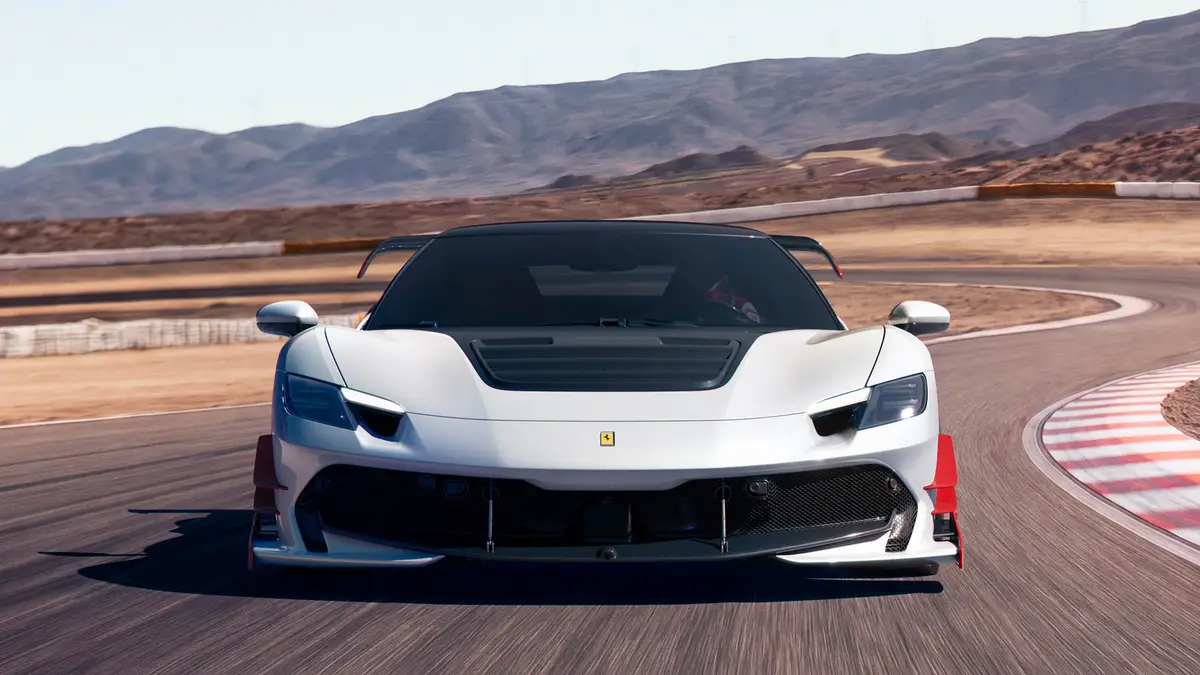
DESIGN EXTERIOR The 296 Challenge Stradale was developed in close continuity with the 296 Challenge EVO, with the aim of preserving its identity as far as possible. The result is a distinctly racing-inspired design, in which the front and rear surfaces are visually streamlined to make the technical functions more clearly discernible. Its distinctive elements arise from the interplay between this approach and the aerodynamic requirements, stylistic considerations, and the type-approval constraints inherent to a road car. The Ferrari Design Studio, led by Flavio Manzoni, sought to make the car's performance and purpose immediately apparent through every design detail.
The front end is dominated by the large technical insert on the bonnet – which incorporates the air outlet from the radiators – and by the two openings near the windscreen that draw air directly from the underbody, thereby helping to generate downforce. The front bumper features a wing suspended between two body-coloured ‘claws’, echoing the front-end layout of the 296 Challenge EVO. At the ends of the bumper are two distinctive air intakes that visually widen the front end. Two flick elements have also been fitted at the sides to increase aerodynamic load.
The layout of the front luggage compartment has been designed with the car’s racing heritage in mind: when the bonnet is opened, the space is deliberately minimalist and free of any unnecessary elements.
The side view retains the compact character of the 296 GTB, reinterpreted through functional appendages and details. The rear is dominated by the fixed wing, supported by hollow struts, and by a black metal mesh that leaves the technical components and exhaust tailpipes visible. The silhouette is completed by the two side wings that frame the design of the rear bumper. The diffuser features two protruding keels, a clear nod to the technical design of the 296 Challenge EVO’s diffuser. The wheels feature a technical architecture with seven twin-spokes, developed with clear racing inspiration.
INTERIOR The cockpit follows the layout of the 296 GTB but can be configured in a more extreme specification, stripping away non-essential elements to evoke the feel of a race car. The door panel is made from a single carbon-fibre component, with no armrest or storage pocket. For the first time on a production car, inspired by the 296 Challenge, an optional specification is available that removes all superfluous trim from the area beneath the seats, the lower section of the carpets, and beneath the centre console, leaving part of the chassis exposed. The central tunnel adopts a deliberately minimalist design: the front fork-shaped element is made of carbon fibre and incorporates the gear selector gate, cupholder, and wireless charging station, while the rear section is entirely made of carbon fibre.
CUSTOMISATION COLOURS AND MATERIALS The livery, available on request, features a bonnet badge, roof graphics, and a strip running along the lower part of the side panels, the bumpers, and the rear wing. Customisable accents highlight the front spoilers and diffuser. The wheels can be ordered in Matte Grigio Corsa, Matte Nero with a diamond-cut finish, or Matte Bianco Fuji; the latter, with its subtle metallic effect, particularly emphasises the wheel’s sculptural form. In the interior, a specific combination of materials – technical fabric and Alcantara® – reinforces the car’s sporty character.
OPTIONAL EQUIPMENT Available equipment includes the carbon-fibre bonnet trim (-0.7 kg) and forged wheels in various seven twin-spoke finishes, which reduce unsprung mass by approximately 11.9 kg (while the carbon-fibre wheels introduced on the 296 GTB naturally remain available). The monolithic aluminium rear tunnel is integrated with black trilobate footrests for the driver and passenger. The carbon-fibre tubular seats, introduced on the SF90 XX Stradale, offer support comparable to that of a race-car seat and reduce weight by 25% compared with standard racing seats. Alcantara® upholstery is available in Nero, Charcoal, Rosso, Azzurro Dino, Giallo Modena, Blu Elettrico, and Rosso Dino, also with contrasting piping and accents.
GENUINE MAINTENANCE Ferrari’s unparalleled quality standards and exceptional customer care form the basis of its seven-year extended maintenance programme, which is also available on the 296 Challenge Stradale. This programme, which applies across the entire range, covers scheduled maintenance for the first seven years of the car’s life.
The main benefits of the Genuine Maintenance programme include scheduled servicing at intervals of 20,000 km or once a year, with no mileage limit, genuine spare parts, and inspections carried out using state-of-the-art diagnostic equipment by personnel trained at the Ferrari Training Centre in Maranello.
TECHNICAL SPECIFICATIONS
* Configuration with optional equipment
296 CHALLENGE EVO PRESS KIT
Designed to push the limits of on-track performance in the Ferrari Challenge Trofeo Pirelli, the 296 Challenge EVO has been unveiled at the Finali Mondiali Ferrari, currently under way in Barcelona. It will make its racing debut in 2027, beginning with the international Europe and North America series, as the single-marque series reaches its 35th year. The car is an evolution of the current 296 Challenge, which has been competing since 2024. That model was the first car in the Prancing Horse’s single-marque series to use a V6 engine, and it achieved the highest downforce levels seen in the series to that point.
Development of the car focused particularly on aerodynamics, vehicle dynamics and broadening its operating window. The aim was to improve outright performance without compromising driveability or consistency on any type of circuit.
The result is a car that is even faster, more efficient and easier to exploit in all conditions. This further strengthens its position as the performance benchmark in its category and brings the driving experience even closer to that of the 296 GT3 Evo.
The tenth model designed for the Ferrari Challenge aims to build further on the car’s strengths to meet the needs of an increasingly demanding clientele. That clientele spans experienced gentleman drivers and emerging young talent, for whom the single-marque series offers a chance to gain experience and build towards a career in motorsport. For them, the step up to GT3 racing is the dream.
In High Downforce (HD) configuration, the 296 Challenge EVO laps Mugello 0.8 seconds faster than the 296 Challenge. This was made possible by the new aerodynamic package and the revisions to the vehicle dynamics, informed by feedback from drivers and teams.
AERODYNAMICS The revised aerodynamic package, a wider range of set-up options and an updated eDiff (electronic differential) provide a more consistent handling balance throughout the race, including over long runs. They also help reduce tyre degradation and wear. The result is a car that is even more stable and predictable on corner entry, mid-corner and on exit.
Compared with the 296 Challenge, the 296 Challenge EVO offers significantly greater adaptability to different aerodynamic requirements. In the previous generation, this adaptation was achieved solely by adjusting the rear wing, with a relatively limited range of adjustment. On the 296 Challenge EVO, however, two standard configurations have been introduced: HD (High Downforce) and LD (Low Drag), the latter characterised by a lower wing angle and the removal of the front aerodynamic appendages. Both configurations ensure the correct aerodynamic balance between the front and rear axles, allowing the car to operate across a significantly wider downforce range.
Added to this is the new high-performance half-shaft, which allows for more extreme set-ups, further expanding the car’s aerodynamic configuration window.
These changes allow the car to be optimised for both technical circuits and very high-speed tracks. Specifically, maximum downforce is 12% higher than on the 296 Challenge (+100 kg at 250 km/h), while the new LD configuration for high-speed circuits reduces aerodynamic drag by 4%. The main components of the aerodynamic package – the splitter, front bumper, rear diffuser and exterior rear-view mirrors – are made from carbon fibre. This material makes it possible to reach higher downforce targets while keeping overall weight in check and simplifying trackside repairs for mechanics.
The 296 Challenge’s already excellent aerodynamics have been further refined through innovative, sophisticated solutions. The most significant changes are to the underbody, front and rear bumpers, rear wing pylons and endplates, and exterior rear-view mirrors.
The 296 Challenge EVO can be configured specifically for high-speed circuits thanks to its wider range of rear wing angles of attack and the option to remove the aerodynamic elements from the front bumper.
The car can be converted to the innovative Low Drag configuration using a dedicated package that involves removing certain front aerodynamic elements: two flicks and one nolder on the wheel arch. This makes it possible to reduce aerodynamic drag by 4 per cent, thereby optimising performance.
At the front, the downforce figures have been achieved by increasing the splitter’s plan area and completely redesigning its profile. In the central section, ground effect has been maximised by lowering the ride height. At the same time, the aero damper introduced on the 296 Challenge continues to fulfil its original function.
The bodywork ahead of the front wheel has been reshaped to generate downforce and improve the car’s handling along typical racing lines.
The central intake for the high-temperature radiator and the brake duct intakes on either side are even more prominent than on the 296 Challenge. Purpose-designed slots around the outer edge of the brake duct intake effectively control the airflow directed towards the front bumper.
An aerodynamic channel has been added on the outer side to direct high-energy airflow beneath the lower flick, ahead of the wheel. By encouraging air to flow outwards, it reduces aerodynamic interference from the tyre, increasing front downforce. The nolder added to the front wheel arch also contributes significantly to this outwash effect and helps draw the wheel wake outwards.
Enlarging the lower flick’s plan area and adding an upper flick complete the measures to increase front downforce.
Finally, a specially designed rear-view mirror has been introduced, similar in concept to that of the 296 GT3 Evo. Its slim, aerodynamically-profiled stalk improves efficiency while maintaining intercooler cooling performance at least equal to that of the 296 Challenge, without compromising rearward visibility in racing conditions. The increase in rear-axle downforce comes largely from changes to the fixed rear wing. The main plane remains unchanged, while the pylons have been redesigned to provide a revised adjustment range. This increases the maximum angle of attack by 4° and reduces the minimum by 1° compared with the 296 Challenge. The rear wing therefore offers two benefits: increased downforce at the maximum angle of attack and reduced drag at the minimum setting.
The new endplates, inspired by aircraft winglets, further increase the wing’s effective aspect ratio, improving efficiency. They also delay the onset of stall, allowing the wing to operate at these higher angles of attack.
The rear underbody has been completely revised: the diffuser has been extended, with its channels projecting further rearwards to increase downforce.
The vortex generators have been moved inwards to harness the higher-energy airflow near the car’s centreline, increasing the suction they produce. The innermost underbody fin extends onto the bumper to form a single vortex generator, with an intermediate slot that energises the airflow and strengthens the resulting vortex. As well as generating more rear downforce, this new vortex generator layout stabilises the car’s aerodynamic behaviour during body movements.
VEHICLE DYNAMICS Updates to the vehicle dynamics controls and the brake pedal force curve allow the driver to fully exploit the increased aerodynamic potential intuitively and progressively. The driver can therefore count on even more predictable handling, more consistent race pace and further reduced tyre degradation.
Braking is easier to modulate thanks to increased pedal travel and force for a given level of deceleration. This allows the driver to get the best from the wider braking range available with the increased downforce.
Agility and stability have also been improved through revised TC (Traction Control) strategies, which enhance performance under combined cornering and acceleration loads, and an upgraded eDiff, which delivers greater stability under braking and increased agility through high-speed corners.
The instrument panel, the main interface between driver and car, has also been updated. Its redesigned display presents driving information and the intervention levels of the vehicle dynamics controls even more intuitively.
One immediately noticeable change is how TC and ABS intervention levels are displayed. The icons are now more dynamic, filling from left to right for TC and from right to left for ABS to indicate the degree of intervention. This allows the driver to read the information quickly, clearly and safely.
The main changes focused on Traction Control, which the driver adjusts on the 296 Challenge EVO using two independent manettino switches, TC1 and TC2. Each offers five settings, from 0, which disables the control, to 4, which provides maximum intervention.
TC1 adjusts the strategies that determine the level of torque reduction applied by Traction Control, while TC2 adjusts the strategies that adapt this intervention to the car’s dynamic behaviour by controlling wheel slip and vehicle stability.
The 1-1 configuration, with both manettino switches set to level 1, has been revised to improve performance and driveability on corner exit and to give the driver more torque to manage with the throttle.
The ABS intervention threshold can be set to four levels using the manettino on the control panel: ABS1 (dry conditions, maximum performance), ABS2 (dry conditions, stability), ABS3 (wet conditions, performance), ABS4 (wet conditions, stability).
The eDiff electronic differential features updated calibrations with two aims. The first is greater stability under braking and on corner entry, with a more linear differential response as the driver lifts off, brakes and turns in. The second is greater stability in fast corners, supported by the increased downforce, allowing the driver to accelerate harder through and out of corners. The revised calibration achieves this by making the car more agile and less prone to understeer.
Like the 296 Challenge, the Evo is fitted with Pirelli tyres, the result of close collaboration between the Maranello Manufacturer and the Milan-based company, a synergy that has been evident throughout the entire development process of the 296 Challenge EVO with the aim of enabling the tyre compound to make the most of the car’s greater potential.
POWERTRAIN The 296 Challenge EVO is powered by a twin-turbo V6 that delivers up to 700 cv at 7,500 rpm – a specific power output of 234 cv/l – paired with a seven-speed dual-clutch F1 gearbox. This follows the approach adopted for the 296 Challenge, the first car in the history of the single-marque series to use a six-cylinder engine, in this case without a hybrid system.
The architecture draws on the Maranello Manufacturer’s six-cylinder engine platform, adapted for numerous track and road cars. Track models include the 296 GT Modificata, unveiled in September 2026; the 296 GT3 Evo; the 499P, which has competed in the FIA WEC since 2023; and the 499P Modificata. Road-going models include the 296 Challenge Stradale, 296 GTB and F80, to name just a few.
OPTIONAL EQUIPMENT Clients can order a range of options as factory-fitted equipment or purchase them later. These include a passenger seat for drivers who wish to work with a coach on track or share the experience with a guest. The seat can be easily removed to return the car to race specification. An LTE antenna enables the Marshalling function, allowing messages from Race Control to be sent to the instrument panel. This equipment will be mandatory for cars competing in Ferrari Challenge Trofeo Pirelli. A silencer is also available for circuits with noise restrictions and can be fitted simply by removing the two exhaust tips.
FERRARI CHALLENGE TROFEO PIRELLI: THE CHAMPIONSHIP The single-marque series will reach its 35th season in 2027. Prancing Horse clients will compete in the international Europe and North America series, each featuring six rounds before the Finali Mondiali, and in the regional UK, Japan and Australasia series, each comprising five rounds. A new Middle East series will also join the regional line-up, with its inaugural round in Bahrain on 11–12 December 2026, followed by rounds in Qatar and Saudi Arabia in January 2027 and in Abu Dhabi in March 2027. In 2027, the 296 Challenge EVO will compete exclusively in the Europe and North America series, before taking to the track in the regional series from 2028.
From 2027, the European series will also introduce a new Endurance race format, with 40-minute races plus one lap scheduled at Mugello, Hockenheim and Valencia. The races will allow two drivers to share a car and will feature a mandatory pit stop.
THE MODELS: 1993 TO THE PRESENT As mentioned above, the 296 Challenge EVO is the tenth model in the Prancing Horse’s single-marque series, first held in 1993. Since then, the series has featured the 348 Challenge (1993–1995), F355 Challenge (1995–2001), 360 Challenge (2000–2006), F430 Challenge (2006–2011), 458 Challenge (2011–2013), 458 Challenge Evo (2014–2017), 488 Challenge (2017–2019), 488 Challenge Evo (2020–2025) and 296 Challenge (2024–).
TECHNICAL SPECIFICATIONS